In short
Barrier impairment changes what the skin can tolerate. Tightness, unexpected stinging, persistent flaking, increased reactivity, lingering redness, and sudden changes in texture can all provide useful clues - but no single symptom proves the barrier is damaged. The goal is to recognize patterns, reduce unnecessary irritation, and restore healthy function before asking compromised skin to tolerate even more.
A compromised skin barrier can change the way skin behaves seemingly overnight. Products that once felt comfortable may sting, flaking can increase despite more exfoliation, and skin may feel simultaneously oily, tight, dehydrated, or unusually reactive. These changes happen when the stratum corneum becomes less effective at retaining water and limiting exposure to potential irritants. Recognizing those signals can help distinguish when skin needs more treatment from when it may need recovery instead.
“My skin suddenly hates everything.”
I hear some version of this all of the time.
“My moisturizer burns now.”
“My face is oily, but somehow it also feels tight.”
“I’m breaking out, so I started exfoliating more and now it’s even worse.”
“I’ve used this product forever. Why is it suddenly irritating me?”
When someone's skin seemingly changes overnight, the instinct is usually to blame the product.
Sometimes that’s exactly what happened, but other times the product isn't necessarily the entire problem.
The condition of the skin receiving it has changed.
And that’s an incredibly important distinction.
A product your skin tolerated beautifully six months ago may feel completely different when applied to a compromised barrier.
So when skin becomes incredibly reactive, tight, flaky, inflamed, or seemingly intolerant of everything we put on it, one of the first things I start thinking about is barrier function.
So let’s explore what that actually looks like.
First: what does “damaged skin barrier” actually mean?
“Damaged barrier” has become one of those skincare phrases that gets used for almost everything.
A breakout? Damaged barrier.
Redness? Damaged barrier.
Dry patch? Damaged barrier.
But clinically, we’re talking about impaired barrier function - a disruption in the structure and processes that normally allow the stratum corneum to regulate water loss and protect the skin from the external environment.
Remember our brick wall? Well here she is again, I won’t bore you.
The corneocytes are the bricks.
Ceramides, cholesterol, and fatty acids form much of the lipid “mortar” surrounding them.
Natural Moisturizing Factor helps maintain water within the corneocytes.
The acid mantle contributes to the skin’s chemical environment.
The microbiome exists alongside all of it.
When that system becomes disrupted, the barrier becomes less effective at doing two incredibly important things:
Keeping water in.
Keeping potential irritants out.
And that’s when the skin starts behaving differently.
Sign #1: Your skin feels tight – even when it looks oily.
This is one of the biggest clues I pay attention to.
Skin should not consistently feel stretched , uncomfortable, or “too small” for your face.
That tight sensation – especially after cleansing – can indicate that the skin has been stripped of too much of what normally helps maintain hydration and barrier function.
And yes… oily skin can still feel tight.
Oil and water are different things.
Sebum on the surface does not automatically mean the stratum corneum is adequately hydrated or that the barrier is functioning optimally.
So if your skin is shiny by noon but feels tight underneath?
Don’t automatically assume you need a stronger cleanser, sometimes that’s exactly the wrong direction.
Sign #2: Products that never bothered you suddenly sting
This one gets people's attention quickly.
You apply your usual moisturizer and … Ow.
It burns.
Or your hydrating serum suddenly stings.
Even your sunscreen feels uncomfortable.
People sometimes assume this means they’ve spontaneously become allergic to everything in their routine. That’s possible – but not always what’s happening.
When barrier function is compromised, substances can interact differently with the skin, increased sensitivity can make normally well-tolerated formulations feel uncomfortable.
The important distinction is that stinging does not automatically mean a product is “working.”
Pain is not a measure of effectiveness.
If something that should be soothing suddenly burns every time you apply it, I want to know why.
Sign #3: Your skin is suddenly much more reactive.
Healthy skin is remarkably resilient.
It encounters temperature changes, pollution, friction, skincare products, sweat, microorganisms, UV exposure, and countless other stressors every day. When barrier function is impaired, that resilience can decrease.
Suddenly:
A cleanser feels harsher.
Cold weather bothers you more.
Sweat sting,
Your face turns red more easily.
A product you’ve used twenty times suddenly feels uncomfortable.
The threshold for irritation has changed.
And that’s something I take seriously.
Because when the skin starts reacting to everything, adding more things isn’t usually my first move.
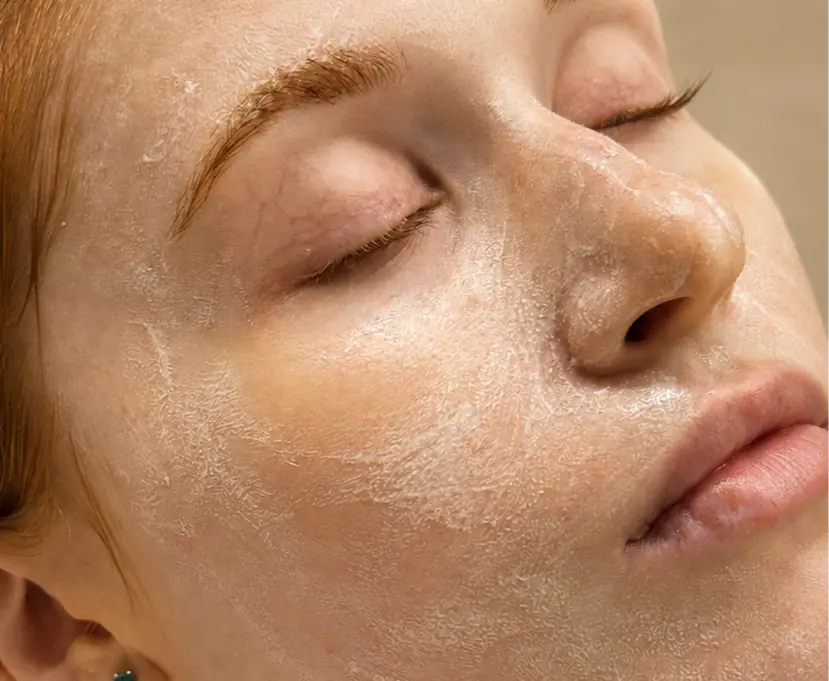
Sign #4: You’re flaky… but exfoliating isn’t fixing it
This is one of my favorite skincare contraindications.
Someone notices flakes.
Naturally, the think:
“I need to remove the dead skin.”
So they exfoliate. Then the skin feels smoother temporarily. Then the flakes come back.
So they exfoliate again, and again.
And eventually they’re exfoliating three or four times a week wondering why their skin somehow keeps getting more flaky.
Here’s the problem:
Flaking doesn't always mean your skin needs more exfoliation.
The stratum corneum requires adequate hydration for normal desquamation – the controlled process through which corneocytes naturally detach from the skin’s surface.
When hydration and barrier function are disrupted, that shedding process may become irregular.
So sometimes those flakes aren’t asking:
“Can you please exfoliate me?”
They’re asking:
“Can you please stop?”
Sign #5: Your skin looks rough, dull, or unusually textured
Barrier impairment isn’t always dramatic.
Sometimes skin simply stops looking like itself.
The surface becomes rough, makeup doesn’t sit properly, fine lines suddenly look more noticeable, the skin looks dull even though you’re exfoliating, texture becomes more apparent.
This makes sense when we understand what’s happening underneath.
The stratum corneum needs adequate water content and properly organized lipids to maintain a smooth, flexible surface.
When hydration decreases and corneocytes begin shedding irregularly, the way light reflects from the skin changes.
That healthy-looking smoothness disappears. And sometimes the answer isn’t another resurfacing treatment.
It’s restoring function.
Sign #6: You’re suddenly breaking out more
This one requires nuance.
Breakouts do not automatically mean your barrier is damaged.
Acne is multifactorial. Sebum production, follicular keratinization, inflammation, hormones, genetics, and microorganisms can all play roles.
But barrier dysfunction and acne can absolutely coexist.
And this is where people sometimes accidentally make things worse.
They notice breakouts.
They add salicylic acid.
Then benzoyl peroxide.
Then a retinoid.
Then an exfoliating toner.
Then a clay mask because TikTok said it “detoxes” their pores.
Now we have acne…
And significant irritation.
At that point, it becomes difficult to tell where one problem ends and another begins.
Acne treatment requires consistency, but the surrounding skin still needs to remain healthy enough to tolerate that treatment.
More aggressive doesn’t always mean more effective.
Sign #7: Redness seems to linger
Temporary redness can happen for countless reasons.
Exercise.
Heat.
Cold.
Professional treatments.
Certain active ingredients.
Even washing your face.
But persistent or increasing redness – particularly when accompanied by burning, stinging, tightness, or flaking — can be a sign that something isn’t functioning normally.
Inflammation and barrier dysfunction also have a complicated relationship.
Barrier impairment can increase exposure to irritant and inflammatory signaling.
Inflammation, in turn, can interfere with normal barrier function.
It can become a cycle.
Which is exactly why calming inflammation matters just as much as replacing moisture.
How did my barrier get damaged in the first place?
Usually?
It wasn’t one dramatic event.
Barrier impairment often develops through cumulative stress.
A little too much exfoliation.
A cleanser that’s slightly too aggressive.
A retinoid every night before the skin has adapted.
An exfoliating acid the next morning.
No moisturizer because you’re afraid it’ll clog your pores.
Hot showers.
Dry weather.
UV exposure.
Then maybe a professional treatment on top of all of it.
Each individual thing may seem manageable.
Together?
The skin eventually says, enough.
Some common contributors include:
Over-exfoliation
Excessive cleansing
Harsh surfactants
Introducing active ingredients too quickly
Combining too many irritating actives
Frequent hot-water exposure
Low humidity
Cold or windy environments
UV exposure
Physical friction or scrubbing
Certain inflammatory skin conditions
Inappropriate post-procedure skincare
And sometimes, multiple factors are happening at once.
The active-ingredient trap
I love active ingredients.
Retinoids, azelaic acid, exfoliating acids, enzymes, antioxidants – these can all have incredibly valuable places in a well-designed routine.
The problem isn’t that actives are “bad for your barrier.”
The problem is assuming that if something is beneficial at one frequency, using it more often must be even better.
Skin doesn't work like that.
There is a point where stimulation becomes irritation.
And once inflammation begins interfering with normal barrier function, continuing to push harder can become counterproductive.
I want the skin stimulated enough to create the response we’re looking for. Then I want it to recover.
That recovery period isn’t wasting time.
It is part of the process.
So… how do you actually repair a compromised barrier?
The first step is usually surprisingly unexciting:
Stop making it worse.
This may mean temporarily reducing or pausing irritating active ingredients depending on the severity of the symptoms.
Then simplify.
A barrier-supportive routine generally focuses on:
Gentle cleansing
Adequate hydration
A well-formulated moisturizer
Barrier-supportive lipids
Reduction of unnecessary irritation
Daily broad-spectrum sun protection
Ingredients such as ceramides, cholesterol, fatty acids, glycerin, panthenol, petrolatum, squalane, and other well-tolerated humectant, emollient, and occlusive ingredients may be useful depending on the formulation and individual skin.
Notice what’s missing?
Seven serums.
Three exfoliating acids.
A scrub.
And whatever product became viral this week.
This is one of those situations where boring skincare can be really, really good skincare
How long does barrier repair take?
There isn’t one universal timeline.
Minor disruption may begin improving relatively quickly once the source of irritation is removed. More significant barrier impairment can take longer.
And if an underlying inflammatory skin condition is contributing, simply changing skincare may not resolve the problem.
That’s why I don’t love promises like:
“Repair your skin barrier in three days.”
Skin biology doesn’t care about marketing deadlines.
Recovery depends on:
How compromised the barrier is
What caused the disruption
Whether the irritating factor has actually been removed
Age
Environment
Existing skin conditions
The products being used during recovery
Individual biology
Instead of obsessing over a specific number of days, I pay attention to changes in function.
Does cleansing feel comfortable again?
Has the burning stopped?
Is flaking decreasing?
Does the skin feel more flexible?
Are normal products becoming tolerable again?
That’s progress.
And sometimes… it isn’t your barrier
This is incredibly important.
Redness, burning, itching, scaling, breakouts, and sensitivity can occur with barrier impairment.
They can also occur with conditions such as:
Atopic dermatitis
Rosacea
Seborrheic dermatitis
Allergic contact dermatitis
Irritant contact dermatitis
Psoriasis
Acne
Skin infections
So I don’t want people diagnosing every uncomfortable skin symptom as “barrier damage” because they saw a checklist online.
If symptoms are severe, persistent, spreading, intensely itchy, painful, oozing, crusting, or repeatedly returning despite simplifying your routine, that’s when I want a dermatologist involved.
Why this matters as a provider
Before performing an advanced treatment, I’m not only asking:
What does this client want to improve?
I’m also asking:
Is their skin currently healthy enough for me to safely ask it to do more?
That’s a completely different question.
Someone may want aggressive resurfacing for pigmentation or texture.
But if their skin is already inflamed, dehydrated, reactive, and unable to tolerate their normal routine, immediately creating additional controlled injury is not the smartest first step.
Sometimes preparation is the treatment plan.
We stabilize.
We hydrate.
We support the barrier.
We improve tolerance.
And then, when the skin is ready, we move forward.
There is nothing passive about that approach.
It’s strategic.
Final Thoughts
Your skin barrier doesn’t have a voice.
But it communicates constantly.
Tightness.
Burning.
Flaking.
Redness.
Sudden sensitivity.
Changes in texture.
Those symptoms aren’t inconveniences to immediately scrub, peel, or medicate away.
They’re information.
And one of the most valuable things you can learn in skincare is how to recognize when your skin needs stimulation – and when it needs recovery.
I think we're living in an era of skincare where people have access to incredibly powerful ingredients.
That’s amazing.
But access to stronger skincare has to come with a better understanding of skin biology.
Because the goal was never to see how much our skin could tolerate.
The goal is healthy, resilient skin that functions well enough to support everything else we’re trying to accomplish.
Sometimes progress means adding something. And sometimes?
Progress is knowing when to stop.
Journal Note
One of the biggest changes in the way I approach skin happened when I simply stopped viewing irritation as something we simply had to “push through.”
There are certain situations where temporary dryness or irritation can occur while adjusting to certain treatments.
But there’s a difference between expected adaptation and skin that is repeatedly telling us it isn’t coping well.
Learning that difference matters.
You don’t get extra credit for having the most aggressive skincare routine. And you skin doesn’t know how expensive your products were.
It responds to biology.
Listen to it.